Yoga is an incredible practice to pair with kayaking. I had the opportunity to guide a wilderness islands trip with Laura Humpf and two incredible ladies. We stayed on Pleasant Island and had the chance to spend a lot of time experiencing the forest, viewing the rhythm of the water and the traveling wildlife. Here are a few images from our journey.
It’s nearing the end of the 4th. The sky is slowly dimming and anticipation for the fireworks grows stronger every hour. Raindrops cover my bike and the potholes on Grandpa’s Farm road have filled with water. The small collections of precipitation are measurable indicators of the incredible day that had just occurred: each drop passing though a moment and settling before seeping into the ground, our experience, histories and memories.
The first time I came to Alaska I couldn’t wait to take my first incredible photo of a whale. Three years later… I am still trying to take a “good” photo of a whale.
I am a firm believer that you create strong photographs through technical experience, a unique story, and a creative eye. Over the years, I have explored the capabilities and limits of my Canon 20D with an L series 24-70mm 2.8 lens to create every image on this site. One camera, one lens - not exactly a professional setup but it is what I have to work with. Equipment is a major limiting factor for the subjects I can capture but I continue to shoot creatively and with the same dedication I would treat more exotic topics. You may not see a fantastic photo of a whale on this blog, but I can guarantee there will be some interesting images of the smaller, more approachable non-mega fauna.
We start with the barnacle.
I like to geek out every once and awhile. Give me a rock, a rising tide, a colony of barnacles, a magnifying glass and I’m in a good mood. These itty-bitty crustaceans are quite cool. A mid-tide intertidal creature, barnacles claim space on any and seemingly all objects within a beach range where they spend the stationary part of their lives in a cycle of submersion and open air. While above water, they close two plates of their shell to form a seal protecting it from drying out as well as to provide a barrier from predators. Once the tide rises, the shell segments open and 6 pair of flickering filaments, called cirri, unfurl busily gathering passing particles, algae, and zoo plankton as waves wash over them. There are several different species of barnacles in Alaska that adapt to lower and higher portions of the tidal range and differ in size and texture. This variety is the Acorn Barnacle.
A look at the size ofbarnacles I was photographing; the paper is college ruled. Here, the barnacles formed on the shells of other organisms, which have since washed up on the beach.
Barnacles on the underside of a rock in the mid-tidal range in Bartlett Cove.
A barnacle feeds while the flooding tide sweeps particles over it. Notice the young, newly attached barnacles to the left of the mature version. The young barnacles build thin shells once they attach to an object after several phase changes in the open water.
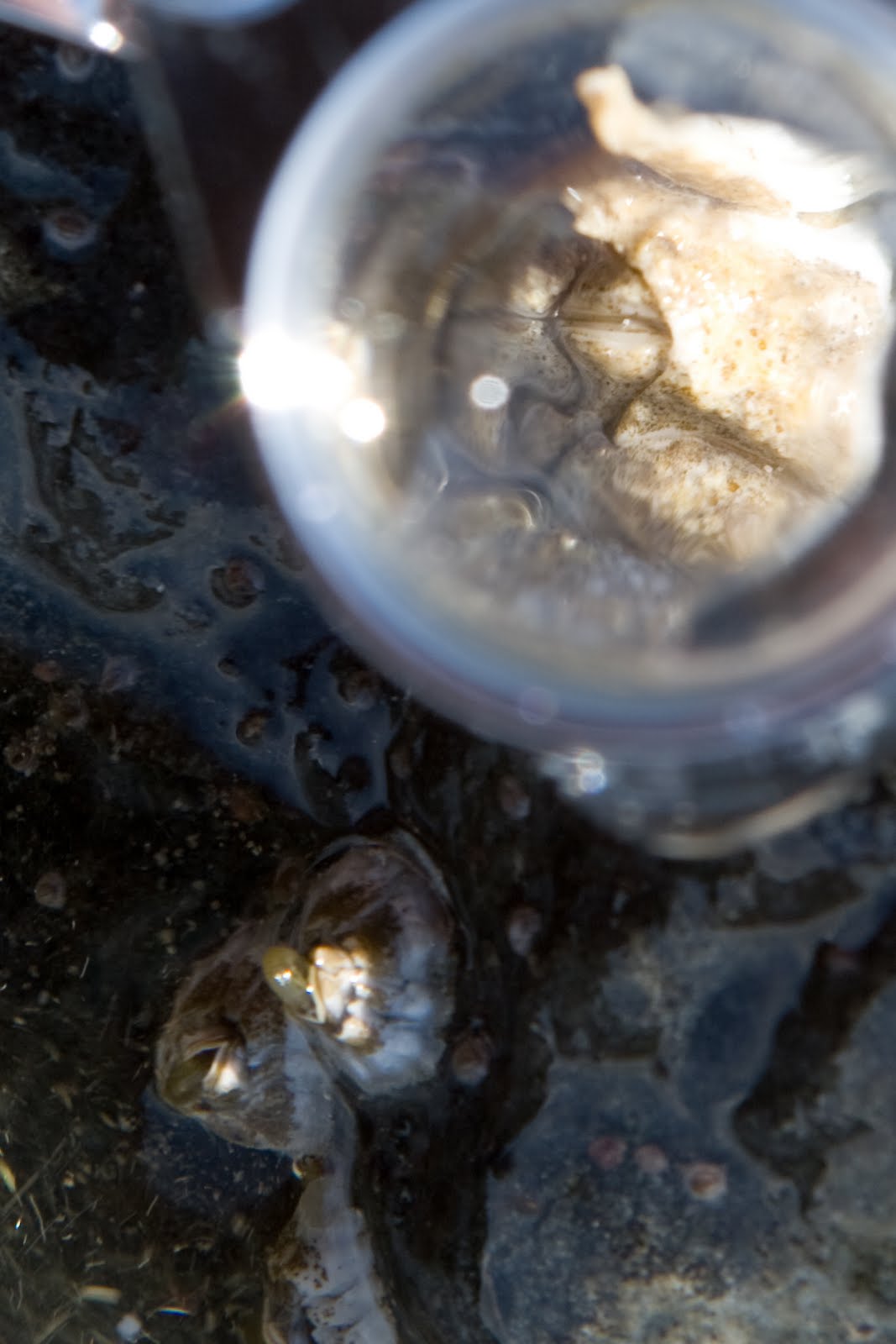
This photograph is the result of an attempt at achieving a detailed view of a barnacle shell with the use of a 4X geological magnifying glass.
Watch your boot heels, as it is quite easy to wipe out an entire community of barnacles in ‘a nails across the chalkboard’ scraping step. The three white “scars” on the rock are the remains of barnacles chipped or broken off.
Information about the barnacle was gained through guide-to-guide knowledge and stories, a few observations as well as the great read: The Nature of Southeast Alaska by Rita M. O’Clair, Robert H. Armstrong and Richard Carstensen.
I recently sat down with three artists from the band The Head and The Heart to interview them for the website Seattle Scenester. You can see the finished article here. We ended up talking for over 40 min, so I couldn’t include everything and therefore decided to throw up a post with the leftovers. Turkey is always better the second day anyway. For those of you wishing for a slightly more candid look, I included some observations as well as a mixed conversation of paraphrased quotes. The band is genuinely fun to listen to and if you are in Seattle I would recommend dancing it up at one of their shows. Notably, May 20th at the Tractor Tavern.
--
We sat in the Seattle sun, the usual water soaked benches breathing and drying from this welcome break in the weather and making our glasses of ice-tea sweat in true form for the coming summer. The guys talked of passion, inspiration, the process and trials of creating a voice, a sound - their music. While they talked, the price of cigarettes was haggled and settled upon with a trade of drinks, spring rolls and future IOU’s. We paused at times to watch pigeons, in stereotypic American style, spend their afternoon eating crumbs of a couple sugary blueberry muffins, cautiously avoiding baby carrots that lay scattered about.
The guys,
T - Tyler Williams. drummer: Virginia
JR - Jon Russell. writer, guitar, vocals: Virginia
JJ - Josiah Johnson. writer, guitar, vocals: California
Coming Together
T –Me, Kenny and Charity - we started in September. In January, we got Chris to start playing bass with us.
JR – It’s really weird because I moved here from Virginia, Josiah moved here from California and neither one of us really had any intention of being in a band again.
So, then we meet each other one on one at Conor Byrne at an open mic a few times… We both respected each other as songwriters and he had a great voice… He started singing to my stuff, I started singing to his stuff and we both realized that harmony was a route we wanted to explore. Which, I had really never done before… People connected with hearing harmony, hearing us sing together.
JJ – We made this band doing stuff. Jon said, “Tyler, you should come out here, we’re making good music.”
T – alright
JJ – and he’s like “well, I think I like your music better than the band I’m in right now.”
T –Jon flew to Virginia to drive out here with me. “Sounds Like Hallelujah” is the one song he brought with him. I had only heard basically “Down in The Valley” before that. We just drove out here and on the way out I was thinking of drum parts for it… we had a daylong practice a couple days after I got here because we had a show the next night.
JJ – that night
T - so, we practiced for 10 hours
JR - he had been here for two days and then he had a show
T – yeah, and that was the one. I don’t think I have changed the drum part since that day, it’s been the same thing and I think it worked out really well.
T - Three months ago, before Chris joined the band, we were outside of a Mexican Restaurant and we were super bummed… and then it seems like as soon as we got Chris onboard the band gelled better, the music came together and the baselines were great. He works really well with me as a rhythm partner and it just seems like everything flows much easier now because the band realized it’s a full band of people who really care about each other and of people who make the music we want to make. I think everybody has the talent to do that in this band.
T - It feels like a family right now. Charity will come over and cook us breakfast.
JJ – She did that last week, it was awesome.
T - Jon and Josiah and I all live together and it feels really, you know, familial. It’s good.
Writing The Music
JJ - I think I am always inspired by personal experience but I end up having a lot of the same feelings other people do.
JJ - There is one song “Honey Come Home,” which is my favorite song writing process I’ve ever had. My friend wrote this story about this old couple …I read it and it hit me. I really felt that story and felt the themes of that story in my own life and I set out to write a song from the whole band’s perspective and it ended up being something that I would want to say too. I thought that was the coolest thing. To have friends share the things they create that then goes and inspires someone to do something in a different medium and have it mean something to them as well.
JR –Each fragment of “Sounds Like Hallelujah” is a different setting. The first part, where it is folkie sounding, Josiah and I were hanging out with these girls that we were dating in this river house in Eastern Washington.
JJ - It was very Great Gatsby
JR - Yeah. Summing up, I was in the bathroom, like locked myself in the bathroom, going why am I still with this girl? What am I doing, you know? I am playing this role of where we will have our good day and in the end we will talk about why something is wrong and the next morning we will forget all about it. I’m just waiting on the sun… basically it is waiting for that stage to happen and then the next day it’s gone and there are these things you do over and over again and it’s like why the hell am I still doing it? The middle portion is this daydream of being glad that I was never in this situation of being in a family that thinks it’s the right thing to do to send you off or put you into the military because it is something that will be good for you. The last half, is me finally being like “alright, I am going to end this thing.” I am just going to fucking do it, and it’s liberating.
JJ – yeah, I do like coming to that moment or that realization. Where you know exactly what you are supposed to do in a situation that has been bothering you for so long. And going - Yes, this is it!
T – It’s defiantly a Hallelujah moment
T - I think we intentionally or unconsciously built tension to get to that moment when it breaks out, it really feels like a break through.
JR - sweet release, ahh we got through all that shit. It’s finally over.
JJ - The arrangement is defiantly written by everyone, but the actually minimal song structure for the most part, except for I think “Ghosts,” all stated out as one person’s song or the other person’s song and then it just morphs into a band song because everyone Kenny, Charity, Chris all add their own pieces and vibes to it. No one gets their way entirely at the end of any song, but it’s kind of cool I guess in that way.
T – full collaboration
JR - If I was to not bring any of my songs to the band, and record them all, it would sound very boring in my opinion... This is clearly a Jon song over and over again, you know, so when I take them to the space we kind of just rip it apart, keep certain pieces and reshape certain pieces.
JR - There is kind of a rule, if anyone has an idea regardless of how sure you are that it may not work with the song, we try it … yeah lets try the idea but if the song doesn’t need it the song doesn’t need it. We all respect our own opinions of what a good song is enough to let that go or to take charge. So yeah, pretty much everyone in the band is a songwriter in a sense. They may not have written the song originally but they have enough of an opinion and a voice to continue the song writing process.
The Sound
T - Music isn’t really regional anymore. Culture isn’t regional.
I – Not as much, no.
T – You can listen to anything anywhere and it doesn’t really matter where you are playing it from. If you connect with it that’s all that really matters anymore.
JJ - Jon and I in general, as songwriters, both discovered in the last year, year and half folkie song writing. I was really into Radiohead; he was really into being a rock star.
JR - What?
JJ – You were, you totally were. You know what I mean, you were totally like Indie Rock, keyboard sounds, I don’t know.
JR – yeah, my solo music before I met Josiah and before I lived in Seattle was defiantly Modest Mouse, Clap Your Hands Say Yeah or Kid Fire, more upbeat.
T – Modern Indie Rock
JR – The Killers for Christ sake, I’ll have to admit
I – Your music has still carried a lot of the upbeat feeling to it.
JR - Yeah that’s Tyler, Tyler can’t stand slow.
T – I feel that not every song has to have the same folkie strumming pattern, so I try to tell them to fuck it up a little bit and switch it up.
JR – yeah, yeah that’s nice
JJ –Totally, anytime I write a slow song, which is pretty much every song, Tyler just goes “really Man, really? you’re depressing me right now.”
T - You just gotta pick it up a little bit
JJ – It’s a little bit of that. It starts off in a folkie place and then gets structured and layered like a good pop song.
JR - We are not trying to be the next big thing. Yes, we want to do this for the rest of our lives, but that has no influence on our song writing, on our passion, on our perspective. So, I think that is something. I think that is one of the best things I have gotten after our shows is that people say, “I can tell that you are genuine; when you are on stage you are not only genuine about like enjoying playing the show for everybody, but when you sing the lyrics and you sing the songs you have written you know that you actually feel that way.” This isn’t just an image that we are creating that we know people can latch onto.
T – It’s who we are.
JR - I think people are latching on because people like to latch onto genuine things.
JR – I think getting back to the regional question…Seattle has a regional feel right now, I feel like.
I – Yeah
JR - There is defiantly a shift of concentration on melody and good song writing again. If you think of Nirvana when anything that is structurally worth a shit is thrown out the door and it’s just pure punk grunge stuff.
T – almost punk rock in a way
JR – I made a point to leave all of my keyboards and try write more songs on guitar and it was a perfect opening to moving to Seattle. I had no idea that I was going to all of a sudden fall in love with folkie sounding music, but I did… Seattle is kind of more used to seeing that sound now [since the Fleet Foxes] you know and it’s like we extracted elements of that and it is part of our sound but we are also coming here with me, more into the indie sound.
T – modern ideas brought to the folkie thing
JR – It’s different enough that people who have been listening to folkie music in Seattle, are noticing that there is something different about it. Yes, we took something that was already happening but its just another layer to what we were already doing. I think that is kind of exciting for people at our shows. We are not cool with people just standing around at a show. You don’t want to see us just standing…So pick up some shakers, a tambourine, and get on stage with us and dance and have fun. I think that is something people are responding to what is a thirst.
Recording and Tours
T – it’s officially an album.
I – yeah Nice.
T – ten songs
I – ten songs, ok. When are you releasing it?
T – Conor Byrne, June 25th
T – yep. It will be available in record stores around Seattle the Tuesday following.
JJ – officially
T - We are looking into unique things to do before that to get people involved and to get them interested in hearing the album.
JJ – We’ll actually have it… are we going to talk about it?
T - I don’t want to talk about it
JR – can’t release these things
T –We’ve got some fun things planned. Just come to the shows you’ll see
JJ - We’re playing two weekends in a row in June where we go from Thursday, Friday, and Saturday. We are going to Salt Lake City on one of them, which is going to be a long drive. Its cool too, friends of ours and friends of Chris’ are having fairly big shows. Generally when bands go on the road for the first time you have to play at a pub to no one and we get to play at really nice venues with really good bands because they are taking us on which is really cool.
T – It’s very nice of them. I guess we are playing something in July. More of a house show tour through CA ending up in LA playing with a good friend of ours Mississippi Man; who are awesome. Include that.
JR - Can we start a record label called Back Pocket Records?
I - probably could
JJ – sure
T – why not
JR – I like that. I would like that.
JJ – we could release this, this release on back pocket records
JR – yeah
T- I don’t mind. I think we just came up with our label. We have a label now.
I – awesome
JR - Can I have a celebratory cigarette?
T – can I have a celebratory cigarette?
JR – I’ll buy you a pack tonight I swear to god
T – I just bought you spring rolls and tea
JJ – I like it.
JR – lets celebrate.
JJ - I like that you have to promise to buy me a pack and you’re “I’ve already paid my dues give me a cigarette.”
Ranging between 50 and 60 years old, these miniature trees have endured a lifetime of manipulation in order to become fascinating and unique pieces of living and evolving art. They reflect the patience, dedication and meticulous planning of their creators through the angle of every branch and even the placement of each leaf. Bonsai. My friend Matthew invited me to join him on a trip to see the Pacific Rim Bonsai collection at the Weyerhaeuser Company in Federal Way. It was open for a limited time and I am quite happy we were able to view the exhibit. The collection is a set of 60 Bonsai ranging in species, age, country of origin and creative process.
The plants are cultivated, many from the wild, and are transferred to growing pots where the roots are trimmed and planted. Rocks, thin soil and regulated water allow the attendants to control the growth rates. The trees are developed to resemble the full size adult version of the species. The trunk to branch ratio and density of the leaves or needles are carefully calculated and controlled through clipping, wrapping and angling wires. This process also allows the artist to create a lean in the trunk, wind swept branches or perfectly symmetrical pieces. It is quite a feat but the result is nothing short of wonderful. I was deeply impressed by the workmanship each tree possessed and how well they represented a large tree. You can easily imagine yourself the size of a Lego man sitting in the shade, listening to the breeze flow through the leaves on a cool summer's eve.